September 30, 2026Features
Board and chip detail: a look inside every hashboard
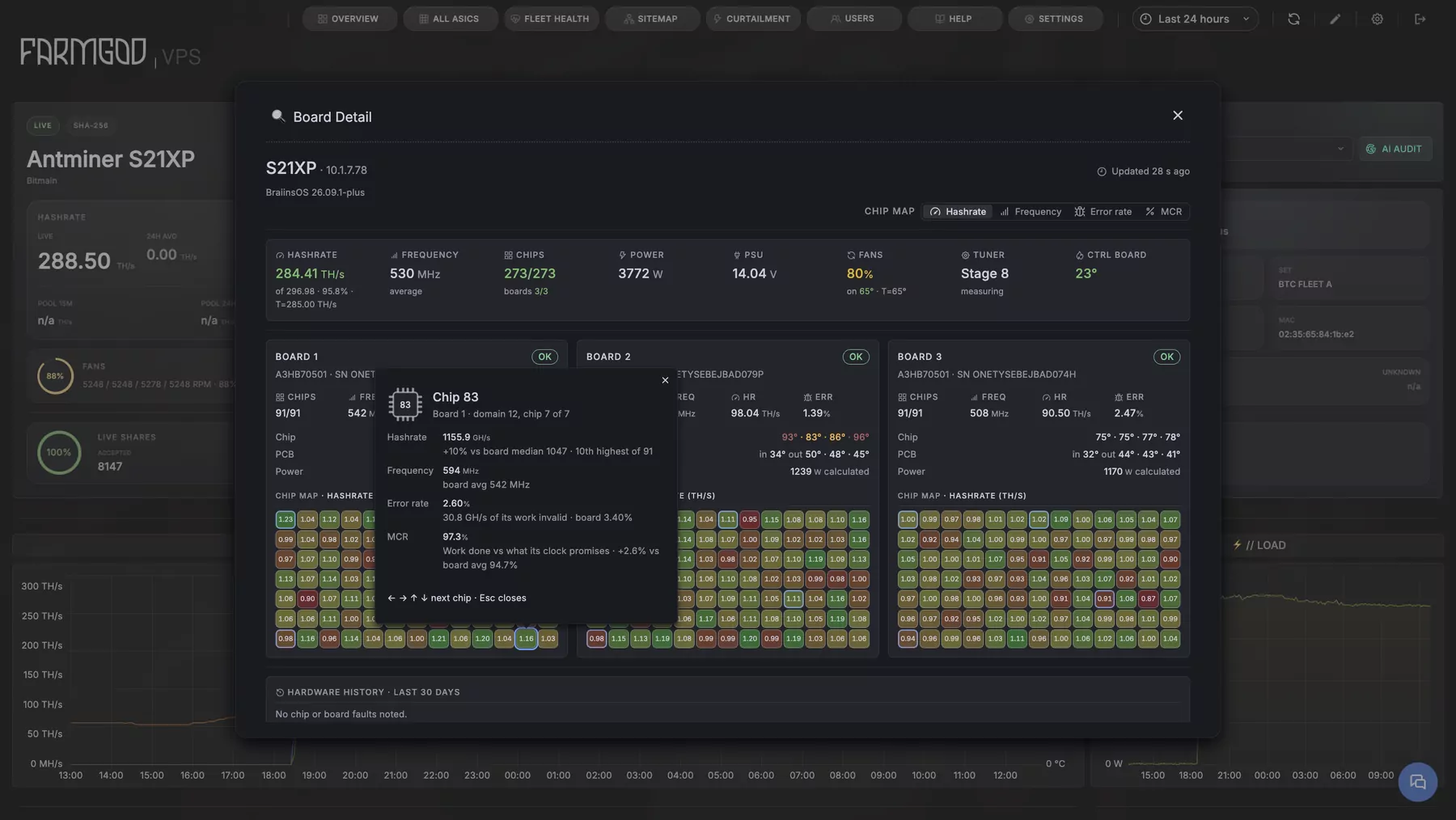
A magnifier on a miner's page now opens its hashboards: chips, frequency, hashrate, errors and temperatures, read live from the miner. For Antminers on stock firmware and VNish, and for Auradine.
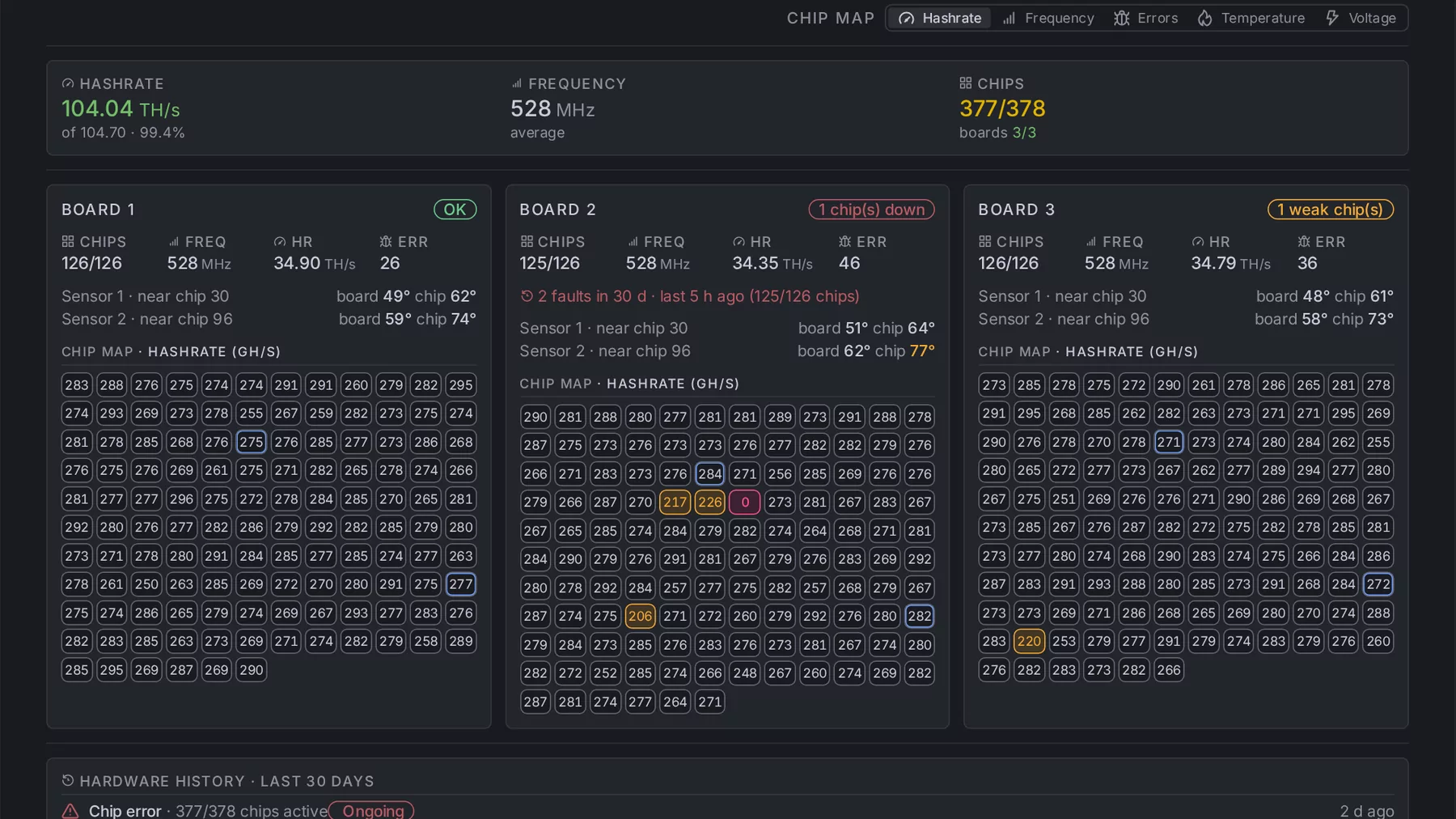
"3/3 boards" is good news. It is also where most dashboards stop. FARMGOD now goes one level deeper: into the hashboard, down to the single chip.
Where to find it
Open a miner and click the magnifier next to its boards. FARMGOD asks the miner itself, the board detail opens, and it refreshes every 60 seconds for as long as it stays open. Nothing is collected while nobody looks, so the view costs a miner nothing for the rest of the day.
What it shows
At the top is the miner: its hashrate against what it should deliver, the average frequency, and the chips and boards found against the ones expected.
Below it, every hashboard has a card with its chips, frequency, hashrate, hardware errors and temperatures, and a badge that says how the board is doing: OK, weak chips, or chips down.
And then the chip map: one cell per chip.
How deep it goes depends on the firmware
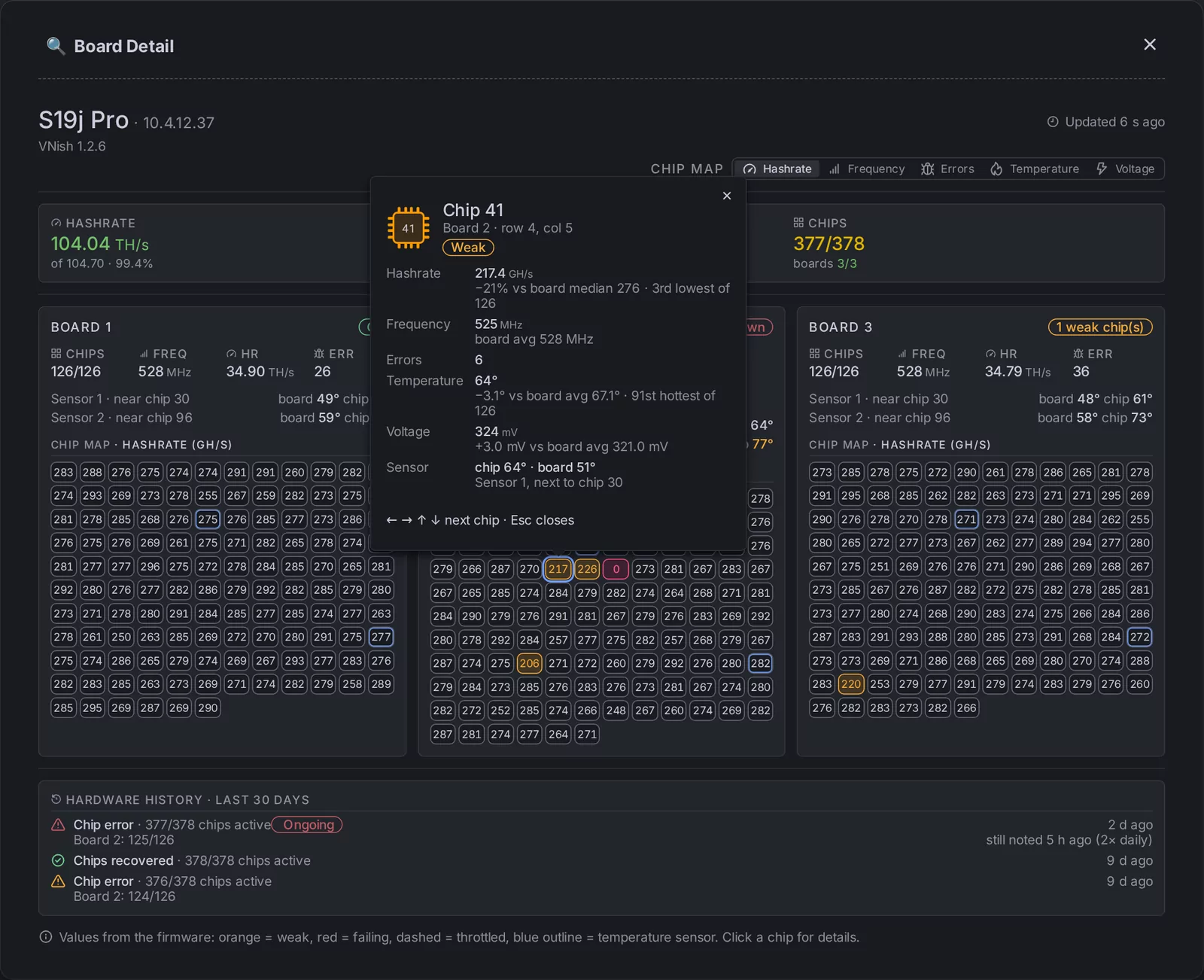
VNish reports the most. Every chip has its own hashrate, frequency and error count, and on models that measure them, its own temperature and voltage. The map switches between them. The firmware's own verdict is drawn in: orange for a weak chip, red for a failing one. Click a chip and it is compared with the rest of its board.
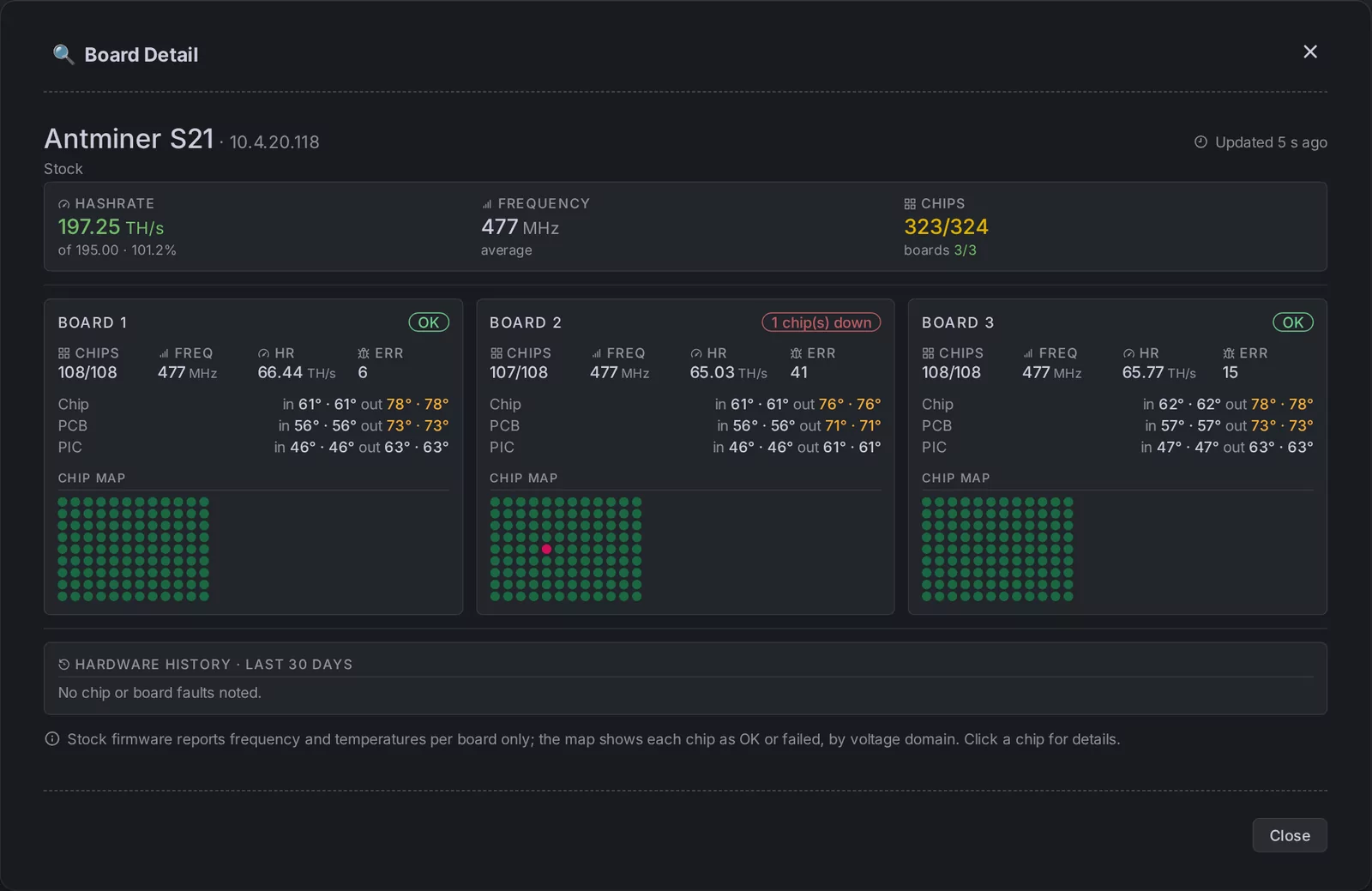
Stock Antminer firmware reports frequency and temperatures per board, at the inlet and at the outlet. Its map shows every chip as working or failed, laid out by voltage domain. That is enough to see which chip took a board down.
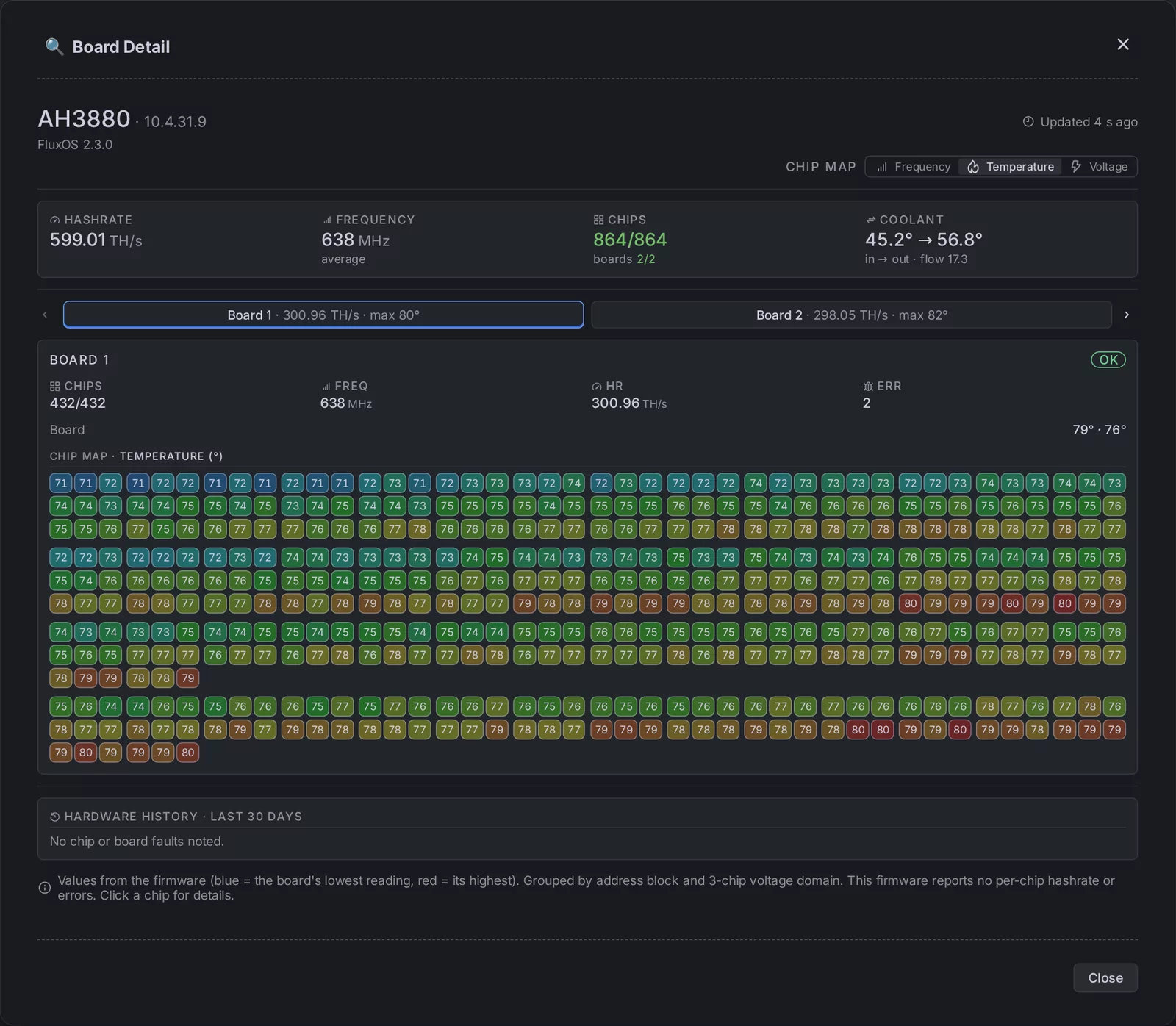
Auradine reports temperature, frequency and voltage for every chip. With several hundred chips on a board, the map shows one board at a time, coloured from the board's coolest chip (blue) to its hottest (red). Next to it is the coolant's temperature going in and coming out.
The hardware history
Under the boards is a list of the chip and board faults FARMGOD noted on this miner over the last 30 days, and when they went away again. A fault that keeps coming back on the same board reads very differently from one bad night.
Why it matters
A board rarely dies all at once. It starts with a few chips that deliver less than their neighbours, or throw more errors. On the map they are visible while the board still counts as healthy. That is the difference between planning a repair and finding out from the pool.
Update, October 2026: Braiins OS has joined the list, with the deepest detail of all. Read Board and chip detail for Antminers on Braiins OS.